As the recent global pandemic has shown, we live in a world where supply chains can change almost overnight. A delayed shipment, regional conflict, supplier shortage, port disruption, or sudden rise in demand can affect purchasing, inventory, sales, and customer service at the same time.
That risk is especially significant for trading and distribution companies in Kuwait. Many businesses rely on imported goods, raw materials, equipment, and spare parts. If shipping routes are disrupted or supplier lead times increase, stock shortages and higher freight costs can quickly put pressure on customer relationships and profit margins.
A connected ERP software solution in Kuwait helps companies manage these challenges by bringing procurement, inventory, warehousing, sales, finance, and supplier information into one system. Instead of piecing together updates from spreadsheets and separate applications, managers can see what is happening across the business and respond sooner.
ERP software cannot prevent every disruption. It can, though, give Kuwait businesses the visibility and control needed to make better decisions when normal supply conditions break down.
Why Supply Chain Visibility Has Become Critical for Kuwait Businesses
Supply chain visibility means knowing how much inventory is available, where products are located, which orders are in transit, and when customers can realistically expect delivery. It also means understanding which suppliers, products, warehouses, and shipping routes create the greatest risk.
Without that visibility, departments may work from different information. Sales representatives may promise stock that has already been allocated. Purchasing teams may reorder goods that are still in transit. Warehouse employees may struggle to locate products across multiple facilities. Finance may not recognize the full cost of delays until margins have already fallen.
An ERP system creates a shared view of purchasing, inventory, sales, and financial information. SAP describes ERP as software that integrates key processes such as finance, manufacturing, and supply chain management. This connection reduces information gaps and gives employees access to more consistent operational data.
For Kuwait trading, retail, distribution, construction, and manufacturing businesses, that visibility can make the difference between reacting late and responding while there are still good options available.
Centralize Inventory Across Warehouses and Branches
Accurate inventory data is one of the foundations of supply chain management. A business needs to know what it owns, what has been reserved, what is currently in transit, and what needs to be reordered.
Manual spreadsheets make this difficult, particularly when a company operates several branches or warehouses. Updates may be delayed, duplicate records can appear, and different departments may use different stock figures.
An ERP platform records receipts, transfers, sales, returns, reservations, and inventory adjustments in one database. Managers can use that information to answer practical questions:
- How much stock is physically available?
- Which goods have already been allocated to customers?
- What inventory is currently in transit?
- Which items are approaching their reorder points?
- Where is each product stored?
- Which customer orders are at risk?
Multi-warehouse inventory management also allows businesses to redistribute existing stock. If one facility has excess inventory while another is running low, the company may be able to transfer products rather than place an expensive emergency order.
This improves product availability while reducing the amount of cash tied up in unnecessary stock.
Improve Demand Forecasting and Stock Planning
Supply disruptions often leave businesses caught between two costly problems: understocking and overstocking.
Too little inventory can lead to missed sales, production delays, and disappointed customers. Too much inventory locks working capital into goods that may move slowly, expire, become obsolete, or require additional storage.
ERP software can combine historical sales, seasonal demand, open orders, supplier lead times, and current stock levels to support more accurate planning. Managers can use this information to set reorder points, establish safety-stock levels, and identify unusual changes in demand.
Forecasts will never remove uncertainty. They do give purchasing teams a better basis for decisions than instinct or outdated spreadsheets.
A Kuwait distributor, for example, could create several purchasing scenarios. One might assume normal delivery times, another could account for moderate shipping delays, and a third could prepare for a longer regional disruption. Managers can then decide which critical goods require additional stock and which products can be purchased only when customer demand appears.
Track Supplier Performance and Reduce Dependency
Finding the cheapest supplier is not the same as building a resilient supply chain. Businesses also need to consider delivery reliability, quality, location, payment terms, production capacity, and exposure to transport disruption.
An ERP system keeps supplier records and purchasing activity in one place. Procurement teams can compare vendors using factors such as:
- Average delivery time
- Frequency of delayed shipments
- Purchase-price history
- Order fulfilment rate
- Product quality and returns
- Contract and payment terms
This information can reveal risks that are easy to miss. A company may discover that one vendor supplies most of a critical item. It may also learn that several suppliers depend on the same port, country, or transport route, meaning they are all vulnerable to the same disruption.
Once these dependencies become visible, the company can qualify alternative suppliers, negotiate backup agreements, or identify replacement products before an emergency occurs.
For a broader view of how connected software supports decision-making, businesses can also explore the role of enterprise applications in modern business operations.
Automate Reordering Without Giving Up Control
Manual purchasing processes become unreliable when demand changes quickly or delivery times become unpredictable. A missed spreadsheet update can lead to a stockout, while duplicate orders can leave the business holding more inventory than it needs.
ERP software can generate low-stock alerts and recommend purchase quantities based on available inventory, sales demand, open orders, safety-stock requirements, and expected deliveries. Reorder points can also be adjusted when supplier lead times change.
Automation should not mean approving every order without review. During a disruption, buyers still need to consider pricing changes, freight costs, supplier reliability, and transport restrictions.
The real value lies in exception management. Routine purchasing can move faster, while employees focus their attention on high-risk products, delayed shipments, and unusual changes in demand.
Strengthen Procurement Controls
A supply chain disruption can create pressure to make emergency purchases. Teams may need to find new suppliers, accept different payment terms, or approve more expensive alternatives at short notice.
Speed matters, but so does control.
An ERP procurement workflow can define spending limits, approval levels, approved vendors, documentation requirements, and escalation procedures. This lets teams react quickly without bypassing the company’s financial policies.
Purchase orders, invoices, receipts, and supplier records can also be connected. Finance and procurement teams can identify discrepancies between what was ordered, what was received, and what was invoiced.
This reduces the risk of duplicate payments, unapproved purchases, and inaccurate cost records at a time when the business can least afford them.
Manage Warehouses More Efficiently
Warehouse performance has a direct effect on supply chain resilience. Even when a business has enough inventory, inaccurate records or inefficient processes can delay order fulfilment.
An ERP platform with warehouse management capabilities can support receiving, put-away, picking, packing, transfers, cycle counts, and dispatch. Barcode scanning can reduce manual entry and make stock movements easier to track.
If a disruption forces the company to transfer stock between warehouses, change fulfilment priorities, or hold goods for key customers, managers can coordinate those decisions using shared information.
ERP reporting can also highlight slow-moving and excess inventory. Rather than ordering additional products, a company may be able to transfer existing stock, bundle it with other items, or offer a targeted promotion. That can release working capital and create more space for essential goods.
Connect Sales Commitments With Available Stock
Customers become frustrated when a company accepts an order and later discovers it cannot deliver. This often happens because sales teams cannot see current inventory allocations, expected deliveries, or purchasing delays.
An integrated ERP platform gives authorized sales employees access to stock availability, reserved quantities, incoming orders, and estimated delivery dates. They can set more realistic expectations and suggest alternatives when a product is delayed.
During a serious disruption, businesses may also need to ration limited inventory. The ERP system can support allocation rules based on contract commitments, customer categories, order dates, or operational urgency.
This creates a consistent process. Instead of making decisions through scattered emails and phone calls, the company can record how and why scarce inventory was assigned.
Monitor Landed Costs and Protect Profit Margins
Supply chain disruptions do more than delay products. They can raise freight, insurance, handling, storage, and purchasing costs.
If those expenses are not captured correctly, a company may continue selling goods at prices based on old cost assumptions. Revenue can look healthy while actual profit margins shrink.
ERP software connects procurement and logistics data with financial records. Finance teams can calculate a more complete landed cost that includes purchase price, freight, insurance, customs expenses, and handling charges.
Managers can then review product margins, pricing strategies, and vendor choices using updated information. If the cost of one item rises sharply, the company can adjust its price, negotiate with suppliers, seek an alternative product, or reduce the quantity purchased.
ERP systems may include procurement, inventory, order management, manufacturing, and supply chain functions, according to Oracle. Connecting these activities helps businesses understand how an operational delay affects costs, cash flow, and customer orders.
Use Dashboards and Alerts to Respond Earlier
Managers should not have to examine hundreds of transactions to discover that an important shipment is late or a critical item is about to run out.
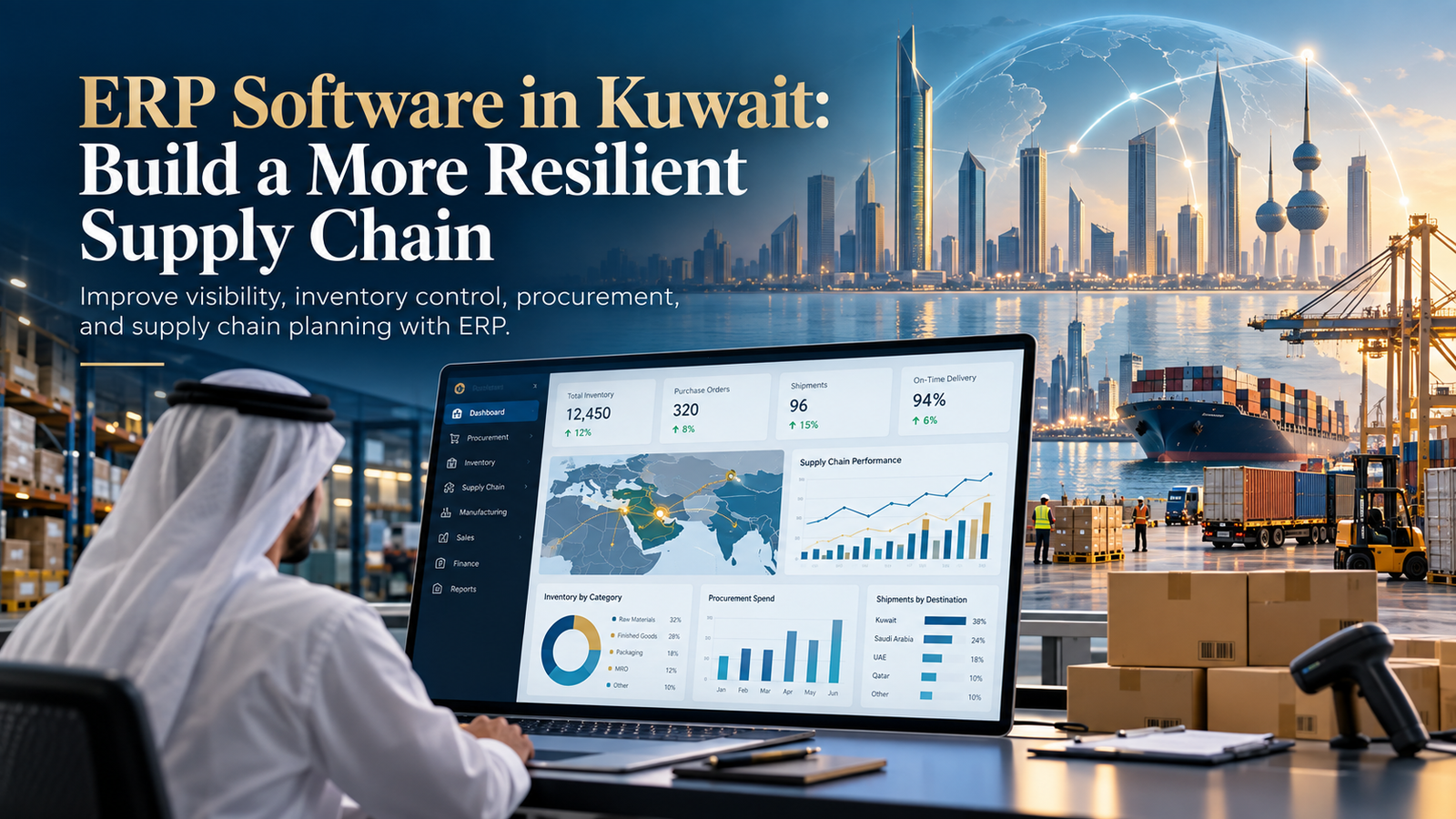
ERP dashboards can summarize indicators such as:
- Inventory shortages
- Overdue purchase orders
- Supplier lead-time changes
- Backorders
- Order fulfilment rates
- Warehouse capacity
- Inventory turnover
- Cash tied up in stock
Automated alerts can notify the right employee when inventory falls below a set threshold, a delivery becomes overdue, or demand rises unexpectedly.
The dashboard does not make the final decision. It makes the problem visible early enough for someone to act. That extra time may allow a business to contact another supplier, transfer stock, change a delivery schedule, or warn customers before the delay becomes more serious.
Use Custom ERP Workflows for Kuwait Operations
No two companies have exactly the same suppliers, approval structures, warehouses, customer commitments, or reporting requirements. A rigid system may force employees to continue managing important tasks outside the ERP platform.
A customized ERP solution can reflect the company’s actual processes more closely. Workflows can be configured around purchasing approvals, inventory transfers, customer credit limits, warehouse responsibilities, and management reporting.
Customization should still be approached carefully. Recreating every old manual process can make an ERP system needlessly complicated. Businesses should first decide which workflows are essential, which can be standardized, and which should be removed.
The goal is not to preserve inefficient habits. It is to build a system employees can use consistently when conditions are normal and when disruptions occur.
Build a Practical Supply Chain Continuity Plan
ERP software is most effective when it supports a clear continuity plan. Technology alone will not decide which customers receive limited stock or which suppliers should be contacted during an emergency.
Kuwait businesses should begin by identifying their most important products, suppliers, customers, and transport routes. They should document minimum stock levels, backup vendors, replacement products, and escalation procedures.
The plan should clarify who can approve emergency purchases, alter customer allocations, change pricing, or move inventory between warehouses. It should also explain how the company will communicate with employees, suppliers, and customers.
ERP records can support this process with current data. Managers can see which products are affected, calculate the financial impact, and track the actions being taken.
The continuity plan should also be tested. A short simulation may uncover outdated contact details, unclear responsibilities, unavailable reports, or approval processes that are too slow for an emergency.
Maintain Accurate Supply Chain Data
An ERP system is only as reliable as the information entered into it.
Inaccurate stock balances, duplicate product records, unrealistic supplier lead times, and outdated bills of materials can produce poor forecasts and unnecessary purchases. During a disruption, those errors become more expensive because managers have less time to verify every figure manually.
Before implementing ERP software, businesses should clean supplier, customer, product, inventory, and pricing records. Each type of data should have a clear owner responsible for maintaining it after launch.
Warehouse teams should record receipts and transfers promptly. Procurement staff should update supplier lead times and purchasing terms. Sales teams should enter orders consistently. Finance should verify cost and payment information.
Good data management is not a one-time implementation task. It is an operating discipline.
Choosing the Right ERP System for Supply Chain Management
When comparing ERP software for Kuwait businesses, companies should focus on operational fit rather than choosing solely by price or brand name.
Important capabilities may include real-time inventory tracking, multi-warehouse management, supplier performance records, demand planning, purchase approvals, barcode support, landed-cost calculations, financial integration, user permissions, and configurable dashboards.
Businesses should also assess integration, scalability, security, backups, implementation support, and employee usability. A system filled with features will not deliver much value if teams find it too difficult to use.
This guide to choosing the right ERP system offers additional factors for companies evaluating their options.
Localization matters as well. The selected system should support the organization’s accounting, currency, reporting, language, and approval requirements in Kuwait. Local implementation support can be particularly useful during data migration, workflow configuration, testing, and staff training.
Learn From a Real ERP Implementation
Practical examples help demonstrate what connected business data looks like in operation.
DSG’s ERP implementation for Alhayat International Company unified operational workflows and supported real-time data visibility. This type of connected structure becomes especially valuable when managers need to respond quickly to supply delays, inventory shortages, or changing customer requirements.
The lesson is simple: ERP implementation should not be treated as an isolated IT project. It affects how employees purchase goods, record inventory, serve customers, monitor costs, and make decisions.
Clear objectives, reliable data, employee involvement, and practical training are just as important as the software itself.
Build a More Resilient Supply Chain With ERP Software in Kuwait
Regional supply chain disruptions cannot always be prevented, but their effect on the business can be reduced.
ERP software gives Kuwait trading and distribution companies a connected view of inventory, suppliers, warehouses, customer orders, costs, and cash flow. That visibility helps teams spot shortages earlier, improve purchasing decisions, protect margins, and communicate more honestly with customers.
The greatest benefit is not simply having more data. It is having reliable information in one place when conditions are changing quickly.
Businesses ready to improve inventory control, procurement visibility, and operational planning can explore DSG’s WizERP solution and its broader range of business software products.